
Babar, Brahms and Brio
4 June 2026
To mark its fifth anniversary, the Vevey Spring Classic sat down with artistic co-director Wilson Hermanto for the Scènes Magazine.
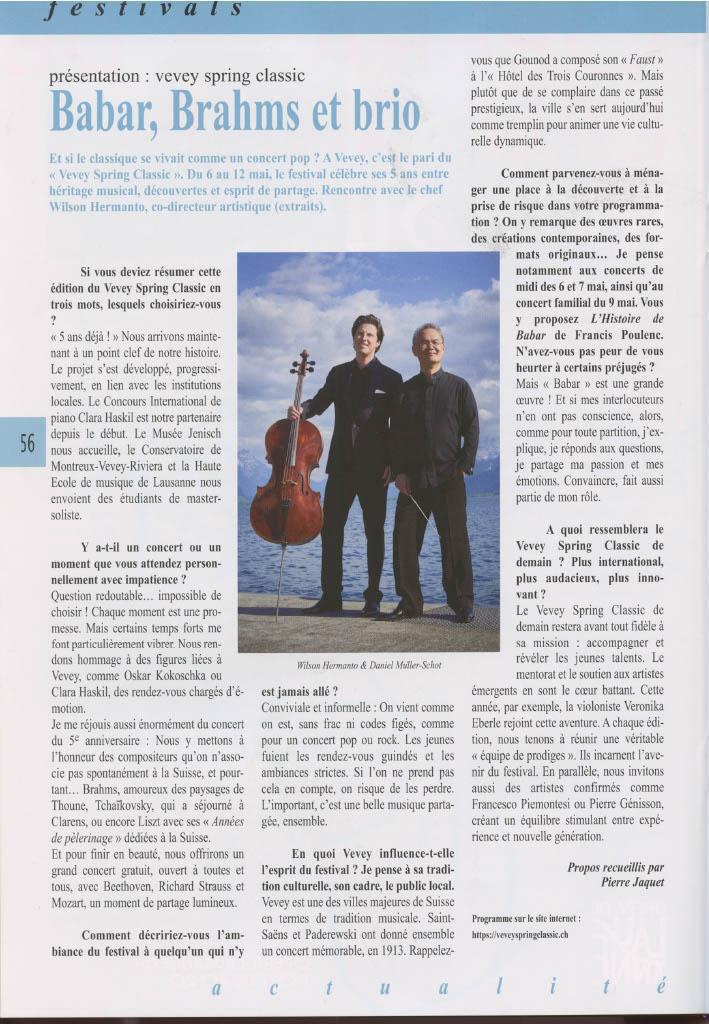
What if classical music could feel like a pop concert? In Vevey, that’s exactly the bet the “Vevey Spring Classic” is making. From May 6 to 12, the festival celebrates its 5th anniversary between musical heritage, discovery and a spirit of sharing. A conversation with conductor Wilson Hermanto, artistic co-director
If you had to sum up this edition of the Vevey Spring Classic in three words, which would you choose?
“5 years already!” We have now reached a key milestone in our history. The project has developed gradually, in close connection with local institutions. The Clara Haskil International Piano Competition has been our partner from the very beginning. The Jenisch Museum hosts us, and the Conservatoire de Montreux-Vevey-Riviera and the Haute École de Musique de Lausanne send us master soloist students.
Is there a concert or a moment you are personally looking forward to most?
A tricky question… impossible to choose! Every moment is a promise. But some highlights make me particularly excited. We pay tribute to figures connected to Vevey, such as Oskar Kokoschka or Clara Haskil — deeply emotional occasions. I am also tremendously looking forward to the 5th anniversary concert: we celebrate composers not usually associated with Switzerland, and yet… Brahms, who loved the landscapes of Thun, Tchaikovsky, who stayed in Clarens, and Liszt with his “Années de pèlerinage” dedicated to Switzerland. And to close in style, we will offer a grand free concert, open to everyone, featuring Beethoven, Richard Strauss and Mozart — a luminous moment of sharing.
How would you describe the festival’s atmosphere to someone who has never been?
Convivial and informal: you come as you are, no white tie, no rigid codes — much like a pop or rock concert. Young people shy away from stiff events and strict atmospheres. If you ignore that, you risk losing them. What matters is beautiful music, shared together.
How does Vevey influence the spirit of the festival? I’m thinking of its cultural tradition, its setting, its local audience.
Vevey is one of Switzerland’s most important cities in terms of musical tradition. Saint-Saëns and Paderewski gave a memorable concert together here in 1913. Remember that Gounod composed his “Faust” at the Hôtel des Trois Couronnes. But rather than basking in this prestigious past, the city uses it today as a springboard to drive a vibrant cultural life.
How do you manage to make room for discovery and risk-taking in your programming? One notices rare works, contemporary premieres, original formats… I think in particular of the lunchtime concerts on May 6 and 7, as well as the family concert on May 9. You are presenting Poulenc’s L’Histoire de Babar. Aren’t you worried about running into certain prejudices?
But “Babar” is a great work! And if my audience isn’t aware of that, then — as with any score — I explain, I answer questions, I share my passion and my emotions. Persuading people is also part of my role.
What will the Vevey Spring Classic look like tomorrow? More international, more bold, more innovative?
The Vevey Spring Classic of tomorrow will above all remain true to its mission: supporting and revealing young talent. Mentoring and nurturing emerging artists are its beating heart. This year, for instance, violinist Veronika Eberle joins the adventure. At every edition, we strive to bring together a true “team of prodigies”. They embody the future of the festival. At the same time, we also invite established artists such as Francesco Piemontesi or Pierre Génisson, creating a stimulating balance between experience and the next generation.
Interview by Pierre Jaquet
